By Bianca Kapteyn
From early science constructs to staggering breakthroughs, the journey to resurrect the dire wolf reads like a collision of fact, fiction, and ambition.
What was once the realm of fantasy—fuelled by pop culture and primeval wonder—has transitioned into reality, thanks to the convergence of genetic engineering, palaeontology, and deep pockets funding the improbable. It took leaps of faith, and futurists willing to challenge nature’s timeline between discovery and imagination.
How did we get there? In the 1990s, it took researchers years to refine the art of DNA extraction. The first animal genome ever sequenced was that of the humble nematode worm—a breakthrough that paved the way for the sequencing of the human genome in 2003.
Nine years later, the world was introduced to CRISPR: the revolutionary genome-editing technology developed by Professor Emmanuelle Charpentier and biochemist Jennifer Doudna. Their work earned the Nobel Prize in Chemistry in 2020 for giving science a powerful tool to edit life itself.
With CRISPR, scientist can now edit the building blocks of life with astonishing precision. In theory, extinct species can be rewritten—resurrected from fragments of genetic memory.
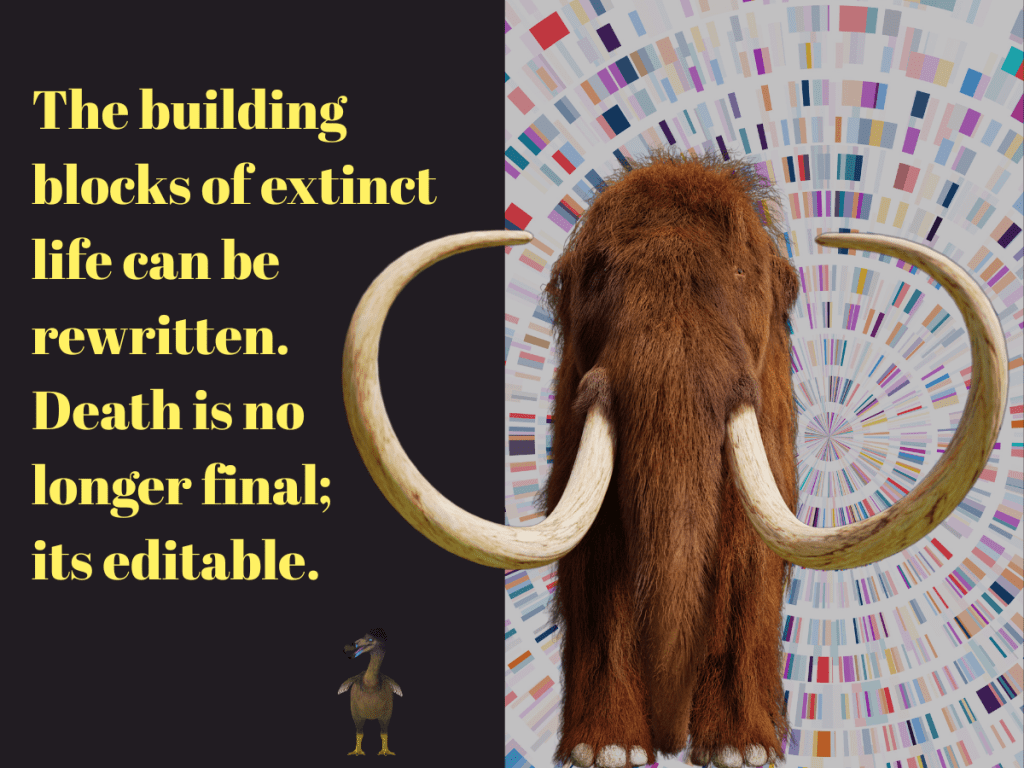
Illustration design by Canine Culture Inc.
The building blocks of extinct life can be rewritten. Death is no longer final; it’s editable.
Trailing behind CRISPR in innovation, Colossal Biosciences emerged as the world’s first dedicated de-extinction company. Co-founded in 2021 by Harvard geneticist George Church and tech entrepreneur, Ben Lamm, Colossal Biosciences is rewriting nature’s playbook. Their mission: to bring back extinct species—including the wooly mammoth, the dodo, and the dire wolf. In 2025, the company announced a stunning milestone: the first phenotype of a dire wolf. Three puppies were born — Romulus, Remus, and Khaleesi — using DNA from ancient dire wolf fossils and genes from the gray wolf as the donor species for establishing cell lines.
Not just symbolic—they’re the beginning of a new frontier in applied genetic science.
Colossal Biosciences also cloned two litters of endangered red wolves—using a new, non-invasive blood technique. Bringing extinct back to life is no longer science fiction—it’s a biotechnological reality.
Few creatures spark the imagination like the dire wolf, an apex carnivore that roamed North America more than10,000 years ago. Colossal’s press release about potential de-extinction pushed the dire wolf into the public sphere. The conversation is no longer limited to palaeontologists and geneticists.
It now includes cultural critics, ethicists, and storytellers. This isn’t just about science — it’s about memory, myth, and meaning. The dire wolf isn’t just a fossil—it’s a cultural icon. Immortalized in literature and fantasy, most notably Game of Thrones, it symbolizes ancient strength, loyalty, and the untamed wilderness. But this mythology blurs the ethical lines.
Are we trying to bring back an animal—or resurrect a myth? If the revived dire wolf doesn’t look or act like the creature of our collective imagination, what then? The risk of turning it into spectacle—rather than respecting it as a living creature with its own biology and needs, is very real.
The drive to bring back extinct species offer stems from powerful sense of loss—what some call “Eco-nostalgia,” a feeling of longing for the past. In reviving the dire wolf, or dreaming of wooly mammoths and dodos, we may not just be restoring nature. We may be chasing a romanticized past, where nature reigned supreme. This nostalgia is emotional and cultural. And it complicates the ethics. Are we reviving ecosystems — or indulging in high-tech fantasy?
The spectre of “Frankensteining” something that no longer existed in our present world is a conversation around de-extinction. There’s a deep cultural unease about reanimating the dead, a discomfort rooted in centuries-old fears of hubris and playing God. With their mythic aura and massive build, dire wolves could amplify that anxiety. Are we reviving an animal—or creating a biotechnological chimera shaped by human desire?
If revived dire wolves become zoo attractions or media darlings, we risk reducing them to living museum pieces. In this way, de-extinction becomes less about biodiversity and more about spectacle. Are we trying to learn from the past—or profit from it?
De-extinction is not just a scientific act; it’s a cultural decision about what—and who—we choose to remember. The dire wolf’s possible return reflects a preference for charismatic megafauna, species with built-in narrative appeal. What about the countless lesser-known species that have gone extinct without fanfare or fantasy?
In choosing to resurrect the dire wolf, we aren’t just reviving a creature — we’re reviving a narrative. And with that story comes responsibility. Who gets to tell it, and what does it say about us?
By examining the de-extinction of the dire wolf through a cultural lens, we gain more than ethical clarity; we deepen our understanding of our own relationship with nature, memory, and myth.
The return of the dire wolf isn’t just a headline about genetics—it’s a mirror held up to our culture. It says something about what we choose to remember, what we long for, and how far we’re willing to go to bring myth into the material world.
De-extinction is more than splicing DNA. It’s a form of storytelling—one written not just in labs, but in hearts, headlines, and history. And while it’s tempting to marvel at the science alone, we also need to sit with the deeper question: Why this animal? Why now?
In the end, the story of the dire wolf isn’t just about what we can bring back — it’s about what we choose to remember, re-imagine, and resurrect. And maybe, what that says about the wildness still lingering in us all.

Bianca Kapteyn, cultural observer and longtime chronicler of canine life.
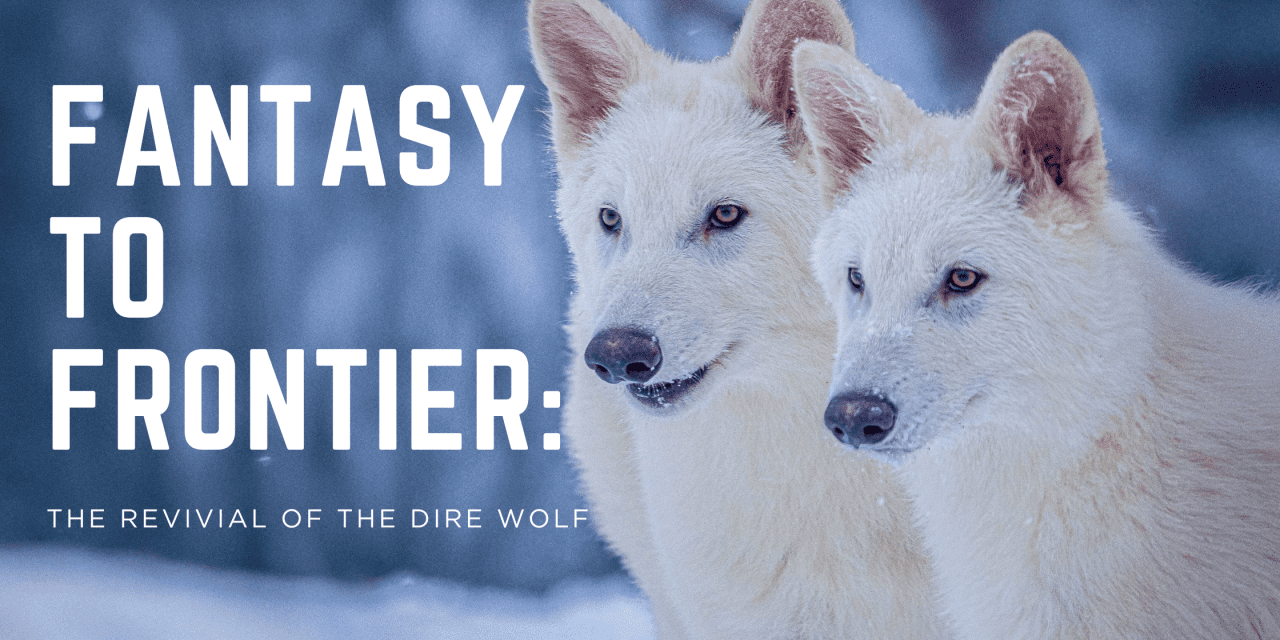
Photo image of dire wolves: courtesy of Colossal Biosciences.